Interstitial condensation in a Dubai building usually forms on the room side of the construction, not the outside, because air conditioning makes water vapour travel inwards. A room held at 24 °C and 50% relative humidity has a dew point of about 12.9 °C; the typical-year average outdoor dew point in Dubai is 23.5–24.5 °C through June, July and August, and the ASHRAE design condition reaches 29.3 °C. Outdoor vapour is pushed towards the cool interior, and it condenses on the first layer it meets that is colder than that dew point.
At an aluminium window that layer is often the internal perimeter seal. On a tower it is often the inner face of a spandrel or slab-edge build-up. The European rule for window joints, inside tighter than outside, was written for heated buildings where vapour moves the other way. Copied unchanged into a cooled Gulf building, it puts the vapour-tight layer on the wrong side.
This guide is for the architect, facade consultant or contractor who details the junctions between aluminium glazing and the structure. The surface condensation on glass and frames that villa owners see is a separate subject with its own guide.
What is interstitial condensation, and how is it different from condensation on glass?
Surface condensation forms on a face you can see and wipe: the outer pane at dawn, or a room-side frame in a humid, over-cooled room. Interstitial condensation forms inside the construction. Vapour moves through the layers of a wall or joint, by diffusion or carried by leaking air, and condenses where it reaches a layer below its dew point.
EN ISO 13788 treats the two as separate assessments. One calculates the internal surface temperature needed to avoid mould. The other assesses the risk of interstitial condensation from water vapour diffusion. The second is the subject of this article, and it is the more expensive failure. It stays hidden until it shows as stained plaster, mould behind a finish, foam that has lost its grip, or corrosion on a steel sub-frame or fixing.
Which way does water vapour move in a Dubai building?
Vapour moves from higher to lower vapour pressure, and in a cooled Gulf building that means from outside to inside. The air-conditioning coil removes moisture from the room air as it cools it. The Building America Building Science Advisor describes the effect in hot, humid climates: the cooling system “often creates a vapor differential between the indoor and outdoor air, resulting in a vapor to drive from the outside to the inside.”
The size of that differential in Dubai is set out below. Indoor conditions are an assumption (24 °C, 50% RH). Outdoor figures come from the ASHRAE 2025 design conditions for Dubai International (WMO 411940) and the TMYx 2011–2025 typical-year file for the same station. Vapour pressures are calculated from the dew points with the Magnus approximation.
| Condition | Dew point (°C) | Vapour pressure (kPa) | Direction of drive vs the room |
|---|---|---|---|
| Room at 24 °C, 50% RH (assumed) | 12.9 | 1.49 | — |
| Outdoor, January daily average (TMYx) | 12.4 | 1.44 | Roughly balanced |
| Outdoor, June / July daily average (TMYx) | 23.7 / 23.5 | 2.93 / 2.89 | Inward, about 2× |
| Outdoor, August daily average (TMYx) | 24.5 | 3.07 | Inward, about 2× |
| ASHRAE 0.4% dehumidification design (26.1 g/kg, coincident 34.4 °C) | 29.3 | 4.07 | Inward, about 2.7× |
| Highest hourly dew point in the typical year (11 August) | 33.3 | 5.11 | Inward, about 3.4× |
Sources: ASHRAE Handbook — Fundamentals (2025) climatic design conditions and TMYx 2011–2025 statistics for Dubai Intl, via climate.onebuilding.org. Ratios are outdoor vapour pressure divided by indoor.
The typical-year averages exceed the assumed room dew point in every month except December and January, so the drive is inward for most of the year. It is strongest from May to October. The practical consequence is simple: any layer inside the construction that sits near room temperature is below the outdoor dew point for much of the year. If outdoor vapour or air reaches it and cannot get past, it condenses there.
Why does the European window-joint rule reverse in the Gulf?
The installation guidance most aluminium window detailing descends from is German. The RAL Guideline on the planning and installation of windows and front doors, as summarised by Henkel’s Teroson, follows the principle “inside tighter than outside” and “requires a higher vapor impermeability (sd-value) for internal sealing.” In a heated building that is correct. Warm, moist room air pushes vapour outwards, so the inner seal stops it and a more vapour-open outer membrane lets the joint dry to the outside.
The manufacturers who sell these membrane systems flag the limit. Sika’s window-installation literature states that “the interior seal must be at least as vapor tight as the outer seal”, and then adds: “Attention, in warmer climates with high humidity and cooled buildings the transport of humidity may change from outside to inside.”
Building-science guidance from hot, humid climates says the same thing as a rule. The Building America advisor states that a vapour retarder “should be placed on the side from which vapor is moving. In a warm climate, that means on the exterior side.” It warns that an interior retarder “will ‘trap’ outdoor vapor and thus allow for condensation on this relatively cooler, impermeable surface,” and names vinyl wallpaper on the room face as one such retarder.
| Heated building (Europe, winter) | Cooled building (Dubai, most of the year) | |
|---|---|---|
| Higher vapour pressure | Inside | Outside |
| Direction of vapour drive | Outwards | Inwards |
| Cold side of the construction | Exterior layers | Room-side layers |
| Where vapour control belongs | Room side (“inside tighter”) | Exterior side |
| Where the joint should dry to | Outside | The dehumidified room |
| Typical trap | Vapour-tight external cladding | Polythene, foil facing or vinyl wallcovering on the room side |
Where does it happen around an aluminium window?
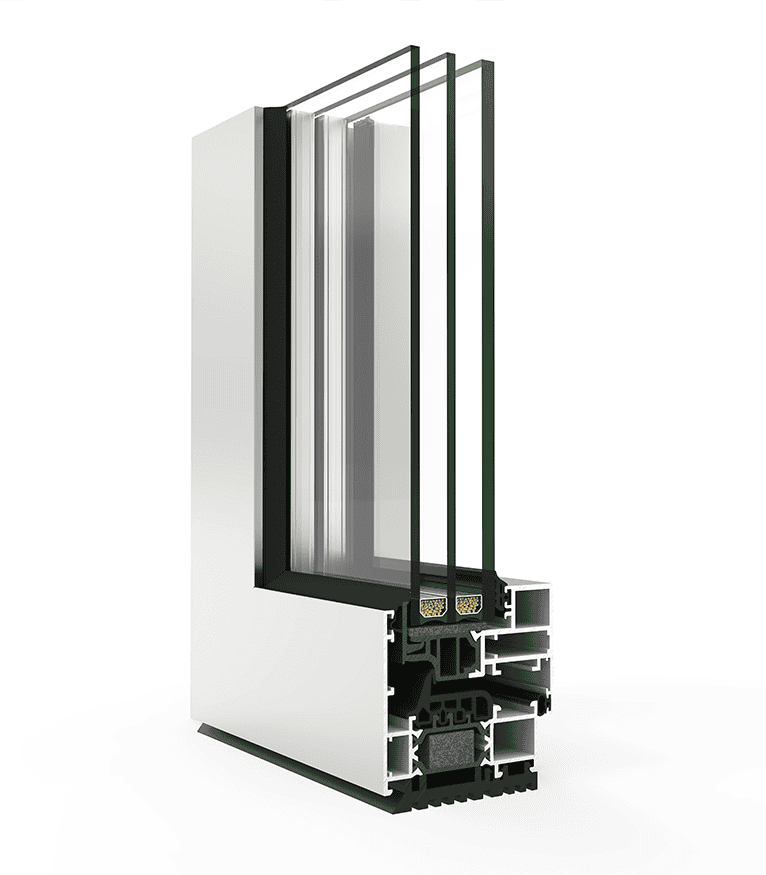
A thermally broken aluminium frame splits into two halves. The outer half follows the outdoor temperature. The inner half, behind the polyamide thermal break, stays close to room temperature. That is the purpose of the break, and it means the room-side half of the opening runs below the summer outdoor dew point. The perimeter joint around the frame has the same temperature profile: warm and humid at the external seal, close to room temperature at the internal seal and the plaster or gypsum reveal behind it.
Detail that joint European-style, with a vapour-tight internal membrane and a vapour-open external one, and outdoor vapour can enter the joint but not leave it. It meets the coolest, least permeable surface in the joint, which is the back of the internal membrane, and condenses there. The places to look are the same on most projects:
- The back of the internal perimeter membrane or sealant, where the joint is coolest and least permeable.
- Expanding foam in the joint, which holds moisture against the frame and the substrate.
- Steel sub-frames, brackets and fixings in the joint zone, which are the first parts to corrode.
- Gypsum reveals and room-side finishes, especially vinyl wallcoverings, which act as the impermeable layer the Building America advisor warns about.
The design principle follows from the direction of drive. Put the primary air and vapour control at the external line, continuous with the wall’s own external air barrier. Keep the internal seal airtight to stop air movement, but do not make it the most vapour-tight layer in the joint. The joint should be able to dry towards the dry, dehumidified room. The right sd-values for a particular wall and membrane combination should be confirmed by calculation, not copied from a European data sheet.
Air-tightness is part of the same problem. Outdoor air leaking through a joint carries its moisture with it, and EN ISO 13788 itself excludes that path. A frame tested to air permeability Class 4 to EN 12207 only helps if the joint around it is equally airtight.
What about curtain-wall slab edges and spandrels?
The same physics applies at a larger scale. Much of the published guidance on spandrel condensation was written for cold climates. Lerch Bates, writing on curtain-wall and storefront spandrels, notes that condensation on spandrel infill “is most likely to occur during extreme winter conditions.” It describes the air space “routinely introduced to prevent thermal damage to the spandrel infill” and the use of back pans so that “if condensation should occur within the insulation, it is outboard of the back pan.”
That arrangement is designed for vapour moving outwards from a warm room. In a cooled Dubai tower the drive is reversed, so the questions are reversed too:
- Which layer in the spandrel is the vapour control, and which side of the insulation is it on?
- Does the spandrel cavity vent or pressure-equalise to the outside? If so, it holds outdoor air at outdoor dew points.
- Which surface in the build-up runs closest to room temperature, and can outdoor vapour reach it?
- Where a ceiling void or return-air plenum meets the slab edge, what temperature does it run at?
Our curtain wall design and specification guide covers spandrel build-ups and fire-stopping. The order of the layers in that build-up should be set by the direction of vapour drive in a cooled building, not by a cold-climate standard detail.
Can EN ISO 13788 predict it?
Partly. EN ISO 13788 is the standard Glaser-type method, and ISO lists the 2012 edition as current. Its interstitial assessment covers vapour diffusion only. The standard states that it does not account for the variation of material properties with moisture content, capillary suction and liquid transport, “air movement from within the building into the component through gaps or within air spaces”, or hygroscopic moisture storage. It is valid only where those effects are negligible.
At a window perimeter or a curtain-wall slab edge, air movement through gaps and air spaces is exactly the path the method leaves out. A Glaser calculation run with Gulf boundary conditions will correctly show which way vapour moves. It cannot show how much water an air leak delivers, or whether a layer dries out between peaks.
| EN ISO 13788 (Glaser method) | EN 15026 (transient hygrothermal simulation) | |
|---|---|---|
| Time step | Monthly, steady state | Hourly, transient |
| Vapour diffusion | Yes | Yes |
| Liquid transport and moisture storage | No | Yes |
| Solar and rain loads on the exterior | No | Yes, from a climate file |
| Best used for | Comparing build-ups and checking the direction of risk | Confirming that a specific detail stays dry over several years |
For a standard villa window joint, the direction-of-drive principle and a correct seal sequence do most of the work. For spandrels, slab edges and any build-up with two vapour-tight layers, a transient simulation run on a Dubai climate file is worth commissioning before the detail is frozen.
What should the specification say?
Interstitial condensation is prevented at the drawing stage, not on site. A specification for aluminium glazing in a cooled Gulf building should state:
- The vapour control layer and its side. Name the layer and place it towards the exterior, continuous with the wall’s external air barrier.
- The perimeter seal sequence. Make the external line the air and vapour control. Keep the internal seal airtight but not the most vapour-tight layer, with sd-values confirmed for the actual climate.
- No impermeable room-side finishes on external walls without a check. Polythene, foil-faced boards and vinyl wallcoverings belong on that list.
- Corrosion protection for anything steel in the joint, on the assumption that the joint will see moisture.
- Air-tightness for the whole opening, with the frame classification matched by the installation.
- A hygrothermal check for spandrels and slab edges, using Dubai boundary conditions rather than a European default climate.
Room conditions matter too. The room-side layers follow the room temperature, so over-cooling a room lowers them further below the outdoor dew point. A sensible setpoint helps the envelope as well as the bill.
Frequently asked questions
What is interstitial condensation?
Interstitial condensation is water that condenses inside a wall, roof or joint rather than on a visible surface. It forms where water vapour moving through the construction reaches a layer colder than its dew point. Because it is hidden, it is usually found late, as stained plaster, mould behind finishes, failed foam or corroded fixings.
Which way does water vapour move through walls in Dubai?
Mostly inwards. A room held at 24 °C and 50% relative humidity has a dew point of about 12.9 °C, while Dubai’s typical-year average outdoor dew point sits between 23.5 and 24.5 °C from June to August. The outdoor air carries roughly twice the vapour pressure of the room, so vapour is driven from outside to inside for most of the year.
Should the vapour barrier go on the inside or the outside in the UAE?
In an air-conditioned building in a hot, humid climate, vapour control belongs towards the outside. The US Building America Building Science Advisor puts it plainly: a vapour retarder should be placed on the side from which vapour is moving, which in a warm climate means the exterior side. A polythene sheet, foil facing or vinyl wallcovering on the room side traps outdoor vapour against a cool surface.
Does the RAL “inside tighter than outside” rule apply to windows in Dubai?
Not without checking. The RAL window-installation guideline asks for the internal seal to be more vapour-tight than the external one, which suits heated European buildings where vapour moves outwards. Sika’s own window-installation literature warns that in warmer, humid climates with cooled buildings the transport of humidity may change from outside to inside, so the seal arrangement has to be designed for the actual direction of drive.
Can EN ISO 13788 predict condensation in a Gulf facade?
Only partly. ISO 13788 assesses interstitial condensation from water vapour diffusion and states that it ignores air movement through gaps and air spaces, liquid moisture transport and moisture storage. At window perimeters and curtain-wall slab edges, air leakage can carry moisture the method cannot see, so a transient hygrothermal simulation to EN 15026 is the better tool where the detail matters.
Does a lower AC setpoint make interstitial condensation worse?
It makes the conditions for it worse. The room-side layers of a wall or joint sit close to room temperature, so cooling the room further lowers their temperature further below the outdoor dew point. Over-cooling is one of the few levers an occupant controls, and keeping to a sensible setpoint reduces the margin by which hidden layers run cold.
Detailing the junction, not just the frame
A high-performance frame does not prevent condensation in the wall around it. The frame, the perimeter joint and the wall build-up have to be designed together, for the direction vapour actually moves in a cooled Gulf building. London Architectural Aluminium engineers and fabricates thermally broken aluminium windows and aluminium sliding doors in our Dubai factory. Our survey and installation guide sets out how we approach the opening. If you are detailing perimeter joints, slab edges or a spandrel build-up, start a specification conversation with our team.
Sources
- ISO, ISO 13788:2012, Hygrothermal performance of building components and building elements: internal surface temperature to avoid critical surface humidity and interstitial condensation. Calculation methods. Scope and stated limitations.
- Building America Building Science Advisor (Oak Ridge National Laboratory), Inward Vapor Drive.
- Sika, Window installation solutions, section on interior and exterior sealing.
- Teroson (Henkel), Windows, summary of the RAL guideline’s “inside tighter than outside” principle.
- Krug, R., Lerch Bates, Condensation at Curtain Wall and Storefront Spandrel Infill (2018).
- ASHRAE Handbook, Fundamentals (2025), climatic design conditions for Dubai International (WMO 411940), and the TMYx 2011–2025 typical-year statistics, via climate.onebuilding.org.