

How to keep aluminium windows, doors and glazed screens performing and in warranty condition in a climate that attacks all four of the things they are made from — the coating, the glass, the seals and the hardware. Written for owners, facilities managers and the cleaning contractors they appoint, and for the trade at fabrication and installation stage.
Download the PDF A4, print-ready — for the O&M file and the cleaning contractor.
Give this to whoever actually cleans the building. More aluminium finish is destroyed in the UAE by well-meant cleaning than by weather. An acidic facade cleaner, a scouring pad or a pressure washer held too close will do permanent damage in a single visit, and no warranty covers it. Where this guide conflicts with the system supplier’s or coater’s written instructions, theirs take precedence.
Standards and practice
LAA is the UAE division of Direct Trade Windows Ltd — UK company no. 04185385, incorporated 22 March 2001 — and this guidance is written to the British and European standards that practice is built on, adapted to Dubai conditions and to the authority having jurisdiction. Where a standard is named, the edition current at the time of the works governs.
- BS 6262Glazing for buildings
- BS 8000-7Workmanship on building sites — glazing
- BS EN 12600Impact classification of safety glass
- BS EN ISO 11600Sealant classification — class 20LM / 25LM
- BS EN 1670Corrosion resistance of building hardware
- BS 6375Performance of windows and doors
- BS 8213-1Design for safety in use and during cleaning
- PAS 24Enhanced security performance — held at the Slough plant
- Qualicoat / QualanodPowder coating and anodising quality, incl. Seaside class
- ASCE 7 / EurocodeWind loading, with the Dubai Wind Code and Dubai Building Code
- ISO 9001:2015Quality management — cert. no. UK-02-VS-02572
Naming a standard here states the basis this guidance is written to. It is not a claim that any particular product is certified to it — certification is stated on the product documentation for the specific system supplied.
1. Why maintenance is different here
A temperate-climate cleaning schedule does not transfer to the Gulf. Six things act on a glazed facade in the UAE, most of them simultaneously:
- Airborne dust and sand. Fine dust settles constantly and is mildly abrasive. It silts up drainage slots, works into sliding tracks where it grinds out rollers, and holds moisture against the finish.
- Salt. Much of Dubai’s prime residential stock — Palm Jumeirah, Jumeirah, the Marina, the Creek frontages, JBR — sits in a marine environment. Salt deposition is continuous and does not wash off in the rain, because there is very little rain.
- UV and heat. Sustained high UV degrades gaskets and sealants and accelerates the natural chalking of any organic coating. Surface temperatures on dark finishes in direct sun run far above shade temperature.
- Hard water. Irrigation overspray and hose water leave calcium and magnesium deposits on glass and frames. Left on, they etch the glass permanently.
- Pool chemistry. Chlorinated water and the vapour above a pool are aggressive to both the coating and to stainless fixings.
- Construction fallout. Cement slurry, render splash, grinding dust and sealant smears from neighbouring works. All of them etch or stain if left to cure.

No coating is maintenance-free, and the warranty says so. Powder coating and anodising are both durable finishes with long guarantees — but those guarantees are conditional on a cleaning regime being carried out and, on marine-grade specifications, on it being recorded. A finish that has never been washed is not a warranty claim. Keep the log in section 9.
2. How often — by exposure
Establish which zone the building sits in and work to that column. Where a single building has elevations in different conditions — a pool elevation and a sheltered courtyard, say — work to the worst case on each elevation rather than averaging.
| Item | Severe — poolside, or within ~1 km of the coast | Moderate — coastal 1–5 km, or heavy traffic | Sheltered — inland, low exposure |
|---|---|---|---|
| External frames and finish | Every 1–3 months | Every 3–6 months | Every 6 months |
| Glass | Monthly, or as appearance requires | Every 1–3 months | Every 3 months |
| Drainage slots and tracks | Every 3 months, and before the storm season | Every 6 months, and before the storm season | Annually |
| Hardware — lubricate and check | Every 6 months | Every 6–12 months | Annually |
| Gaskets, seals and perimeter sealant | Inspect every 6 months | Annually | Annually |
| Internal frame surfaces | At least annually — internal faces are the ones everybody forgets. | ||
| After a shamal or sandstorm | Rinse down as soon as practicable, whatever the schedule says. Wind-driven sand left sitting against a finish is abrasive and holds salt. | ||
Newly completed buildings need an extra cycle: wash down at handover, and again once the last of the neighbouring wet trades have finished. Construction fallout does far more damage in its first six months than the weather does in five years.
3. Cleaning the frames
The method, for every finish
- Rinse loose dust off first with clean water. Washing a dusty frame without rinsing first drags grit across the finish — that is how fine scratching happens.
- Wash with clean warm water and a pH-neutral detergent, at a dilution safe to handle with bare hands, using a soft cloth, sponge or soft-bristle brush. Work all the ridges, grooves, joints, gasket lines and drainage channels where salt and dust collect — those are where corrosion starts.
- Rinse thoroughly with clean water. Residue left to dry on the surface can itself stain or etch.
- Dry with a soft cloth or leather. In this climate, letting hard water air-dry on the frame simply replaces the dirt with mineral deposits.
Do not clean a surface that is hot or in direct sun. Any chemical reaction is accelerated on a hot surface, the water evaporates before it can be rinsed, and the result is streaking and uneven cleaning that will not come out. Work the shaded elevation, early morning or late afternoon, and follow the shade round the building.
Powder-coated aluminium
- All organic coatings chalk slightly in service and lose some gloss. This is normal weathering, not a defect.
- Where gloss has dropped or light staining has set in, an approved renovating cream may be applied carefully with a non-abrasive cloth, then polished with a soft cloth to bring back gloss and colour uniformity. A mild automotive paint restorer can be used provided it is not too abrasive.
- Go carefully on arrises and corners. The coating is naturally thinner on sharp edges, mitres and bead arrises, and it is easy to cut straight through to bare metal. Do not repeat this operation often — every pass removes coating.
- A wax polish once or twice a year adds protection and is worthwhile on severe-exposure elevations.
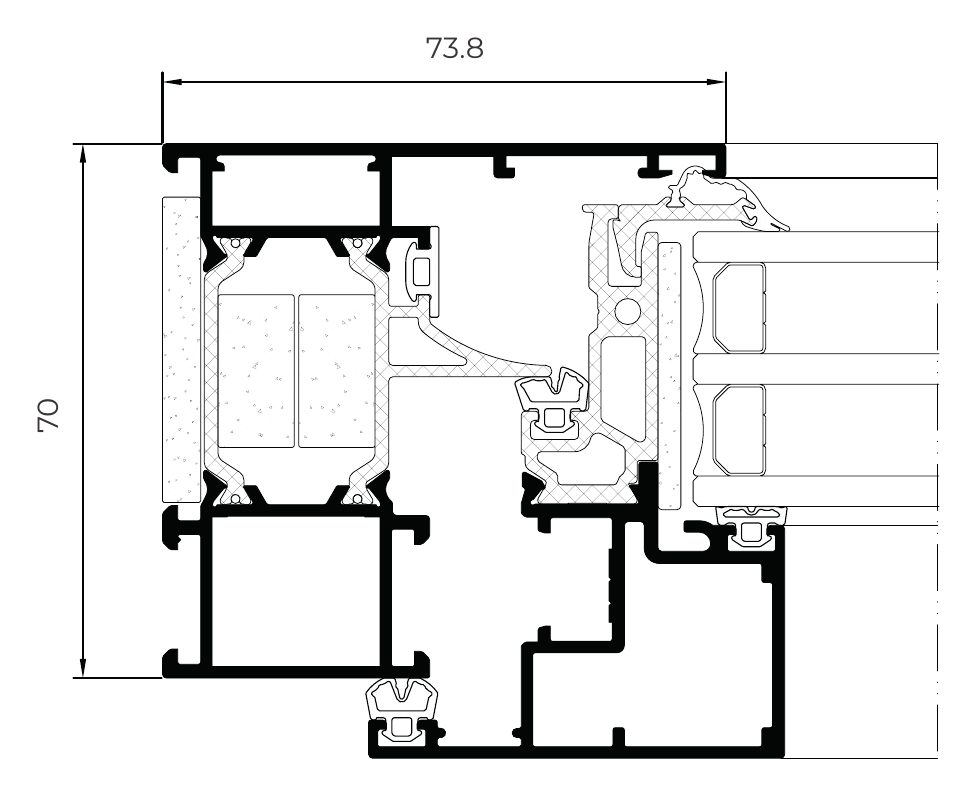 1
2
3
4
5
6
- 1External face — the surface the cleaning schedule is about
- 2Polyamide thermal break — keep solvents out of the joint
- 3Centre gasket, frame to sash — dust packs along this line and it stops sealing
- 4Glazing gasket at the unit edge — where run-off and salt concentrate
- 5Insulating glass unit — never scraped, never cleaned with an acidic product
- 6Outer weather gasket, and the rebate that has to stay clear to drain
Anodised aluminium
- Clean by the same method, but the chemistry rules are stricter and there is no equivalent of a touch-up.
- Never use acidic or alkaline cleaners. Anything containing phosphoric acid, hydrochloric acid, hydrofluoric acid, fluorides or trisodium phosphate will attack the anodic film. Keep the pH between 6 and 8.
- Never use abrasives or a renovating cream. The anodic layer is the metal surface itself, converted — polish through it and the damage is permanent and visible as a bright patch. Powder coating can be touched in; anodising cannot.
- Rinse especially thoroughly at crevices and joints. Trapped cleaning residue is a common cause of staining on anodised work.
What must never be used on any aluminium finish
- Acidic facade or “cement remover” cleaners. These are in routine use by general cleaning contractors in the UAE and they are the single most common cause of permanently damaged aluminium here. Say so in writing when you appoint a cleaner.
- Strong alkaline cleaners, caustic products and oven cleaners.
- Abrasive pads, wire wool, scouring powders and blades or scrapers.
- Solvents, paint thinners and removers on the finish. White spirit or an approved solvent may be used to lift grease or mastic at fabrication and installation stage (section 8), but not as a routine cleaning product.
- High-pressure washers at close range. Pressure drives water past gaskets and into drainage paths, and will strip sealant. If a pressure washer is used at all, keep it at low pressure, wide fan, and well back.
4. Cleaning the glass
- Rinse first, then wash with clean water and a pH-neutral detergent, and squeegee or dry off. Do not let it air-dry.
- Never use a blade or scraper on coated, laminated or toughened glass, and never on any glass carrying a surface coating or film. Scraping leaves permanent fine scratching that is only visible once the sun is on it — by which time it is too late.
- No acidic cleaners. They attack the coating, the edge seal of an insulating unit, and the frame finish below.
- Clean out of direct sun, for the same reason as the frames.
- If the glass carries a solar-control, low-E, self-cleaning or applied film, follow that manufacturer’s instructions — several of them rule out particular products.
Hard water and irrigation overspray
This is the most common avoidable glass problem on Dubai villas, and the one clients are angriest about because by the time it is visible it is usually permanent.
- Mineral-laden water dries on the glass and leaves calcium and magnesium deposits. Each cycle adds another layer, and in time the deposits etch into the glass surface itself. At that point no cleaning will remove them — the glass has to be polished professionally or replaced.
- Prevention is the entire answer. Walk the property with the irrigation running and watch for any head throwing water onto the glass or the frames. Most heads adjust for direction and arc. Doing that once costs nothing; removing etching costs a pane.
- Deal with deposits at the earliest stage, while they are still a surface film. Ground-floor glazing beside planting beds is where it always starts.
- The same applies to the frames: repeated sprinkler overspray on a powder-coated sill will leave a mineral crust and eventually a visible mark.
Construction fallout
Cement splash, render slurry, plaster, grinding dust and sealant smears must be removed immediately, with water, before they cure. Once cured, removing them takes either an acidic product or mechanical abrasion — both of which damage the finish, and neither of which is a warranty matter. On an occupied site with work continuing nearby, protect the glazing rather than relying on cleaning it afterwards.
5. Drainage, tracks and weathering
This is the section that prevents actual failures rather than cosmetic ones. Aluminium systems are drained and pressure-equalised: water that gets past the outer gasket line is designed to collect and discharge through slots in the frame. Block those slots and the system stops working — water backs up, finds the internal seal line, and appears inside as a leak that looks like a failed installation but is a failed clean.
 1
2
3
4
5
6
- 1Leaf bottom rail and interlock gasket — dust packs into the gasket line and it stops sealing
- 2Stainless running rail — grit here is what grinds out the rollers
- 3Open channels between the rails — where wind-blown sand collects. Vacuum before washing
- 4Brush seal — combs flat and packs with sand; check it still touches the leaf
- 5Drainage channel and discharge — silts up invisibly. Soft brush and low-pressure water only
- 6Track-to-floor junction — inspect the perimeter seal for loss of adhesion
- Check and clear drainage slots to the schedule in section 2, and always before the storm season. Fine dust silts them slowly and invisibly.
- Clear them with a soft brush and low-pressure water. Never push wire, a screwdriver or a drill into a drainage slot — you will strip the coating inside the channel and start corrosion exactly where it cannot be seen or repaired.
- Vacuum sliding and folding tracks before washing them. Grit in a track is what destroys rollers and carriages; it grinds the running surface and the wheels together. A door that has become heavy to slide has almost always been running on dirty track.
- Do not grease a sliding track. Grease collects sand and turns into a grinding paste. Keep tracks clean and dry; lubricate only the points the system manufacturer specifies, with the product they specify.
- Clear brush seals and gasket lines of compacted dust — a brush seal packed with sand no longer seals and accelerates wear on the leaf.
- Check that external finishes have not buried the drainage. New paving, a raised planter or an added screed can cover the discharge point entirely. This is a common retrofit failure.
6. Gaskets, seals and perimeter sealant
- Inspect annually — more often on severe exposure. You are looking for splitting, chalking, hardening, shrinkage at corners, and any loss of adhesion where the perimeter sealant meets the frame or the structure.
- Report perimeter sealant failure early. A 50 mm loss of adhesion is a half-hour repair; the water damage behind it six months later is not.
- Clean gaskets with water and neutral detergent only. Do not dress EPDM gaskets with oil- or solvent-based products — they swell the rubber and shorten its life. If a silicone-based conditioner is used, confirm it is compatible with the gasket and will not contaminate a face that will later be sealed.
- Do not paint over sealant or gaskets, and do not let a decorator do it either.
- Gaskets and weatherstripping are replaceable. If a gasket is damaged during re-glazing or repair it should be replaced rather than re-used, or the weather performance of the unit is compromised.
7. Hardware
Hardware is the part of a window that has moving parts and the part most likely to generate a complaint. Most of those complaints are adjustment and lubrication, which are maintenance items, not defects.
Windows
- Lubricate friction stays and locking gear periodically to minimise wear and keep operation smooth, using the lubricant the hardware manufacturer specifies.
- Do not lubricate the friction pads. Oil on a friction pad destroys its braking action and the vent will then swing in the wind. Pad resistance is adjusted with the brass screws fitted in each pad.
- Check that restrictors operate and release. A restrictor that has seized shut is an escape problem.
Doors
- Lubricate hinges, multipoint locks, keeps and cylinders periodically. Use a suitable lubricant in the cylinder, not oil.
- Floor springs and overhead closers need checking for closing speed, latching action and any leakage. Closing forces drift over time and in the heat.
- Heavy leaves — pivot doors and large entrance doors — benefit from an annual check of alignment and of the pivot or hinge fixings.
Sliding and folding gear
- Keep the track clean and dry, as above. This single habit does more for the life of a sliding door than everything else combined.
- Check rollers and carriages for flat spots, noise and free rotation. Adjust height only at the adjustment points provided.
- On lift-and-slide gear, confirm the leaf lifts and drops cleanly and that the gasket compresses evenly when the handle is turned down.
Stainless steel in marine air
Exposed stainless fittings on coastal sites can develop light surface rust — “tea staining”. On correctly specified A4/316 it is a cosmetic effect of salt deposition, not a structural failure, and it is largely preventable by washing to the schedule. Remove it with a proprietary stainless cleaner, never with an ordinary steel wool pad, which embeds carbon steel particles and makes it far worse.
8. Repair
Coating damage on aluminium
Blisters and corrosion sites start wherever bare aluminium is exposed — mechanical damage or scratches through the coating, and at cut bar ends, mitres, butt joints, drill holes and drainage slots, which are the places the coating never reached in the first place. On a coastal site these will start visibly corroding within a season if left.
For small areas of damage on powder-coated or organically coated aluminium:
- Remove corrosion products and any non-adherent coating with fine 120–360 grit abrasive paper.
- Wipe with white spirit or an approved cleaning solvent.
- Make sure the surface is completely dry, then apply a thin priming coat with a fine brush and allow 20–30 minutes to flash off.
- Touch in the primed area with an air-drying paint, again with a fine brush.
Two honest limits on touch-up. First, air-drying paint does not weather like a stoved coating — it will not hold colour or gloss the same way, so confine it to small areas of damage and expect it to need renewing. Second, anodising cannot be repaired by this method at all. There is no touch-up for an anodic film; damage is either lived with, or the component is replaced or re-anodised. Anyone offering to touch in anodising with paint is offering you a visible patch.
Glass and components
- Broken glass. Windows and doors can be re-glazed and the gaskets and weatherstripping renewed using the correct materials for the system. Replacement glass must match the original specification — build-up, coating, toughened or laminated, and coating orientation. Substituting a cheaper unit changes the performance the building was approved on.
- Damaged hardware. Furniture and fittings are replaceable by releasing the fixing screws and changing the item. Use the system manufacturer’s part, not a visually similar substitute — on a fire-rated or tested assembly, a substituted component invalidates the certification.
- Refer to the supplier for system-specific parts, gasket profiles and glazing materials. Keep the finish reference and system name from the handover pack; matching a finish five years later without it is guesswork.
9. At fabrication and installation — for the trade
Most in-service corrosion is decided before the product ever reaches the client.
- Seal every cut end. All cut bar ends, mitres, butt joints, drainage slots and drill holes should be coated with an air-drying system — primer or corrosion inhibitor plus a topcoat — or a suitable gap sealant, to protect the exposed aluminium. This is not optional on coastal or otherwise aggressive sites, which in the UAE is most of them.
- Remove grease, dirt and mastic spillage with white spirit or an approved solvent that will not soften the coating or harm its weathering.
- Never leave self-adhesive tape or clear lacquer on a finished surface. In UAE heat and UV, adhesive bakes on within weeks and removing it takes the coating with it. Protective film has a stated maximum exposure period — observe it, and never leave film on an installed unit through a summer.
- Watch for swarf on benches, end damage to assembled frames in transit and on site, and the careless use of sharp-ended screwdrivers to force snap-fit beads into position.
- If coating is damaged and bare aluminium is revealed, repair it immediately by the procedure in section 8. Do not deliver it and hope.
10. Specifying for this climate
- Specify the coating for the exposure. Marine-grade and seaside-class powder coating specifications exist precisely because standard architectural classes are not intended for continuous salt exposure. The pre-treatment differs, not just the powder. Decide this at specification stage — it cannot be retrofitted.
- Specify the fixing and hardware grade to match — A4/316 stainless on coastal sites, and no untreated carbon steel in contact with aluminium.
- Agree the cleaning regime at handover, in writing, and hand it to whoever will actually carry it out. Where an enhanced marine warranty applies, confirm what the coater requires to be recorded and how often.
- Tell the client the truth about frequency. Cleaning interval is driven by two things: the environment, and the appearance standard the client wants to hold. Both are their decision, and both should be on the record.
11. Maintenance record
Keep this with the O&M file. On a marine-grade coating warranty it is not paperwork — it is the evidence the warranty is conditional on.
| Date | Elevation / area | Work carried out | Products used | Defects noted | By |
|---|---|---|---|---|---|
| Frames · glass · drainage and tracks · hardware · gaskets and sealant — record each, with anything found and reported. | |||||
What typically voids a finish warranty
- No cleaning regime, or no record of one where the specification required it.
- Acidic, alkaline or abrasive cleaning products, or mechanical abrasion.
- Damage left unrepaired so that corrosion initiated at bare aluminium.
- Construction fallout left to cure on the finish.
- Protective film left on beyond its stated exposure period.
- Substituted glass or hardware that changes a tested or certified assembly.
Need a maintenance regime written for a specific building?
LAA fabricates and installs aluminium glazing across Dubai and the UAE from Al Qusais Industrial Area 4, and can set out a cleaning and maintenance schedule against the actual systems, finishes and exposure on your project — or carry it out. Send us the schedule or the handover pack.
London Architectural Aluminium L.L.C. · Al Qusais Industrial Area 4, Dubai, UAE · +971 4 295 9945 · info@laa.ae · A division of Direct Trade Windows Ltd · ISO 9001:2015, certificate no. UK-02-VS-02572 · See also the Guide to Survey & Installation.