An aluminium window’s air-tightness class tells you how much air leaks through its closed joints under wind pressure, and in Dubai that is also a measure of how much fine dust and humid outdoor air it lets in. Under EN 12207, Class 4 is the tightest rating: at 100 Pa the window may leak no more than 3 m³/h per square metre of window, against 27 m³/h for Class 2, and it must hold that limit all the way up to a 600 Pa test pressure. It is a strong indicator of how well the seals are designed. It is not a noise rating, and it says nothing about the joint between the frame and the wall.
This guide explains what the classes actually measure, why the same gaps carry air, dust and sound, and what to ask for on a Dubai villa or apartment so the rating on the datasheet survives installation. It is written for owners who want a quieter, cleaner home, and for specifiers who need the numbers behind “Class 4”.
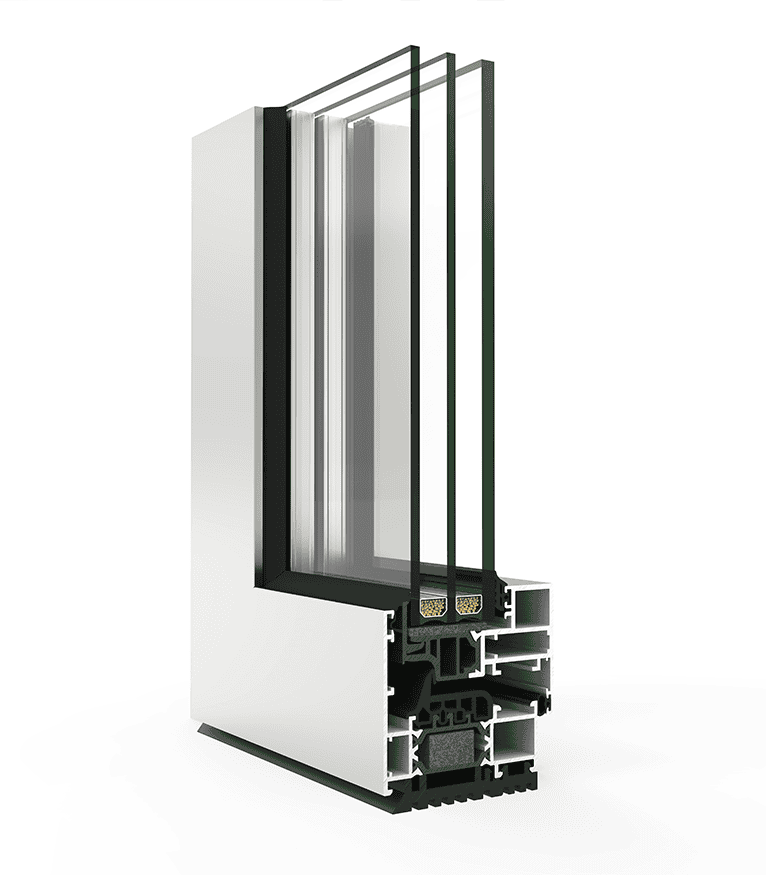
What does an air-tightness class actually measure?
It measures the air that passes through a closed, locked window when the air pressure on one side is higher than on the other. The test method is EN 1026. The window is mounted in a sealed test rig, and air leakage is measured at rising pressure steps, both positive (as on a windward face) and negative (as on a leeward face). EN 12207 then sorts the result into Class 1 to Class 4, with Class 4 the most airtight.
Each class has two limits. One is per square metre of overall window area. The other is per metre of opening joint, which is the length of seal around every sash or leaf that opens. Both are set at a reference pressure of 100 Pa. The standard then scales each limit to every other test pressure using Q = Q100 × (p/100)2/3. To be classified, the window has to stay under the limit at every pressure step up to that class’s maximum.
| EN 12207 class | Limit by window area at 100 Pa | Limit by opening-joint length at 100 Pa | Maximum test pressure |
|---|---|---|---|
| Class 1 | 50 m³/(h·m²) | 12.50 m³/(h·m) | 150 Pa |
| Class 2 | 27 m³/(h·m²) | 6.75 m³/(h·m) | 300 Pa |
| Class 3 | 9 m³/(h·m²) | 2.25 m³/(h·m) | 600 Pa |
| Class 4 | 3 m³/(h·m²) | 0.75 m³/(h·m) | 600 Pa |
Two features of the table matter in practice. First, each step is a large one: Class 4 allows one-third of the leakage of Class 3 and about one-ninth of Class 2. Second, a class is a ceiling, not a measurement. A window classified as Class 4 leaks no more than the Class 4 limit in the test, and a well-made unit may leak far less.
How much pressure does a shamal put on a window?
Enough to make the test pressures relevant. The National Centre of Meteorology’s shamal forecasts commonly give north-westerly winds of 28–38 km/h, rising to 60 km/h at times in coastal areas. Its dust alerts have reported gusts of up to 45 km/h with visibility below 2,000 m.
The pressure that a moving air stream can exert is its dynamic pressure, ½ρv². Assuming an air density of 1.2 kg/m³, a 45 km/h gust has a dynamic pressure of about 94 Pa and a 60 km/h wind about 167 Pa. The pressure actually acting across a particular window will be some fraction of that, depending on the building’s shape, the face it sits on and the pressure inside. Even so, the order of magnitude is clear. A strong shamal puts windward glazing in the range of 100–170 Pa. That is already beyond the 150 Pa ceiling at which a Class 1 window stops being tested, and well inside the 600 Pa to which a Class 3 or Class 4 window is proven.
Why is air-tightness also a dust rating in Dubai?
Because airborne dust needs moving air to carry it, and on a closed window the moving air goes through the same seal lines that EN 12207 tests. Coarse sand drops out at the drainage chambers and gasket lips. Fine particulate follows the air. The tighter the seals, the less air passes through and the less dust it can bring with it.
The dust load in the northern Emirates is substantial. A year-long PM10 study in Sharjah, next door to Dubai, measured an average of 137 µg/m³ in the cool season and 210 µg/m³ in the hot season, and 761 µg/m³ during a severe dust storm on 31 July. The authors identify desert dust, crustal minerals and sea salt as the major natural sources, with dust events concentrated between April and the end of October.
The worked example below shows what the class difference means on one window. Assumptions: a 1.5 m × 1.5 m window (2.25 m²), leaking at exactly its class limit by area, scaled with the EN 12207 formula. The dust column multiplies that airflow by the 761 µg/m³ storm concentration. That is an upper bound, since some particles are caught in the joint rather than passing through, and it assumes the storm and the full pressure happen together.
| Condition | Class 2 window at its limit | Class 4 window at its limit |
|---|---|---|
| Air leakage at 10 Pa (a light, everyday pressure difference) | ≈ 13 m³/h | ≈ 1.5 m³/h |
| Air leakage at 167 Pa (60 km/h dynamic pressure) | ≈ 86 m³/h | ≈ 9.5 m³/h |
| Upper-bound PM10 carried in at 167 Pa and 761 µg/m³ | ≈ 65 mg per hour | ≈ 7 mg per hour |
The absolute figures depend on the assumptions. The ratio does not: at the class limits, a Class 4 window passes one-ninth of the air of a Class 2 window at any pressure, and therefore at most one-ninth of the airborne dust. Across a villa with thirty or forty openings, that is the difference between dust on the sills after every shamal and dust you rarely notice.
Does air leakage add to the cooling load?
Yes, and in Dubai the bigger part of it is moisture rather than heat. Outdoor air that leaks in has to be cooled, and it also has to be dried. The 2025 ASHRAE Handbook design conditions for Dubai International give a dehumidification design point of 29.3 °C dew point, which is 26.1 g of water per kg of dry air. A room held at 24 °C and 50% relative humidity holds about 9.3 g/kg.
A worked example using the 10 Pa row above: the Class 2 window at its limit admits about 13 m³/h, which carries roughly 260 g of water an hour into the room at that design condition. That is about 180 W of latent load the air-conditioning has to remove. The Class 4 window, at about 1.5 m³/h, admits roughly 30 g an hour, or about 20 W. These are per-window figures at the class limits, so they show scale rather than a forecast for a real house. The same humid air is also what forms condensation on cold surfaces indoors, which we cover in why condensation on aluminium windows runs backwards in Dubai.
The regulation is moving in the same direction. Al Sa’fat, Dubai’s green building system, requires air-conditioned buildings with a cooling load of 1 MW or more to achieve whole-building air leakage of no more than 5 m³/h per m² at 50 Pa (§501.05). That is a test of the whole building, not of the windows alone, and it is the perimeter joints that usually decide it.
Is a Class 4 window also a quiet window?
Not automatically, and this is where the rating is most often over-read. Sound and air do share their leak paths. Al Sa’fat makes the link explicitly: §401.08 requires the frames of exterior doors and windows to be sealed with materials that “prevent the transmission of air and sound” caused by pressure differences across the building envelope. A window that leaks air will always have a ceiling on its acoustic performance, because sound passes straight through an open gap.
The reverse does not hold. Air-tightness and sound insulation are tested and classified separately. A window’s acoustic figure, Rw, comes from a laboratory sound-transmission test, and it is governed mainly by the glass build-up: pane thicknesses, acoustic interlayers and the cavity. A Class 4 window with standard double glazing can still be a modest acoustic performer. So read the two figures as a pair. Class 4 shows that the seals will not undermine the glass. The Rw figure shows how much the glass can do. For road-facing bedrooms, our guide to aluminium glazing and traffic noise in Dubai explains why even Rw overstates performance against traffic, and what to specify instead.
Do sliding doors reach the same class as casement windows?
The good ones do, but it depends on how the leaf seals. Casement, tilt-turn and pivot vents seal by compression: the sash is pulled hard against continuous EPDM gaskets, which is why they classify well. A lift-and-slide door also seals by compression. The leaf is lifted clear of its seals to move and then lowered back onto them, so well-engineered lift-and-slide systems publish Class 4, the same as a casement. We compare the three formats in detail in aluminium sliding vs pivot vs casement.
A basic in-line slider is different. Its leaves have to slide while closed, so it typically relies on brush or wiping seals rather than compression gaskets. Before accepting any sliding system for a dust-exposed elevation, ask for its tested EN 12207 class rather than assuming it. Among the aluminium window systems we fabricate, every one that lists an air-permeability class on our windows page lists Class 4. Examples include Schüco AWS systems, Cortizo COR 80 Industrial and Altest WDS70.

Why can a Class 4 window still leak once it is installed?
Because the test leaves out the joint where most installed leakage happens. In an EN 1026 test, the gap between the frame and the test rig is sealed before measurement begins. The class therefore describes the window. It does not describe the joint between the window and the building. In a Dubai villa that joint runs between an aluminium frame and a blockwork or concrete opening that is rarely square. That opening moves with the heat of the day, and the joint is often finished with a single bead of sealant over a gap packed with whatever was to hand.
That is why a Class 4 window in a poorly sealed opening leaks around the frame rather than through it. Air, dust and sound all take that path. In our Dubai factory, the profiles, gaskets and corner joints are controlled. On site, three things decide whether the rating survives:
- A continuous perimeter seal, inside and out. That means an air-seal line on the room side and a weather seal outside that lets the cavity drain, not one bead of silicone carrying both jobs.
- A sealant joint sized for movement. Aluminium expands with heat. A joint that is too thin, or bonded on three sides, tears in the first summer.
- Adjusted, undamaged hardware and gaskets. A sash that is out of adjustment does not compress its gasket evenly, and a cut or stretched gasket corner is a leak at every pressure.
Our survey and installation guide covers the opening preparation and sealing sequence step by step.
What should you specify for a Dubai villa?
- EN 12207 Class 4 on every opening window and door, backed by a classification report from a notified test laboratory rather than a brochure claim. It should cover both positive and negative pressure.
- Watertightness and wind-load classes to match (EN 12208 and EN 12210), set according to height and exposure rather than accepted as a default.
- The tested class for sliding systems specifically, with lift-and-slide preferred on dust-exposed or coastal elevations.
- A stated Rw (with Ctr) for noise-exposed rooms, alongside the air class, since the one does not imply the other.
- A perimeter sealing detail on the drawings showing the inner air seal, outer weather seal and joint dimensions, so the installed result can be checked against something.
Frequently asked questions
What is the best air permeability class for windows?
Class 4 under EN 12207 is the most airtight classification for windows and external doors. At 100 Pa it allows no more than 3 m³/h per m² of window, or 0.75 m³/h per metre of opening joint, and it is tested up to 600 Pa. It is the right baseline for any opening unit in Dubai.
Does a Class 4 window keep out shamal dust?
It sharply reduces it. Fine dust is carried by air, and at its class limit a Class 4 window passes one-ninth of the air of a Class 2 window at any pressure. The installed perimeter joint has to be sealed to the same standard, because the class test does not include it.
Are airtight windows also soundproof?
No. Air-tightness stops the seals from undermining acoustic performance, but the acoustic rating (Rw) is set mainly by the glass build-up and is tested separately. Specify both an air class and an Rw with Ctr for noise-exposed rooms.
Do aluminium sliding doors leak more air than hinged doors?
Basic in-line sliders usually do, because they rely on brush or wiping seals. Lift-and-slide doors seal by compression when the leaf is lowered, and well-engineered systems reach Class 4, the same as a casement. Ask for the tested EN 12207 class of the specific system.
What air leakage does Al Sa’fat require?
Al Sa’fat §501.05 requires air-conditioned buildings with a cooling load of 1 MW or more to achieve whole-building air leakage of no more than 5 m³/h per m² at 50 Pa. Separately, §401.08 requires all new buildings to seal exterior door and window frames against the transmission of air and sound.
Why do my new windows let in dust if they are rated Class 4?
Most often the leak is around the frame, not through it. The EN 1026 test seals the frame to the test rig, so the rating excludes the installation joint. Check the perimeter sealant, the sash adjustment and the gasket corners.
Specifying air-tightness that survives installation
An air-tightness class is one of the most useful numbers on a window datasheet in the Gulf. It is a proxy for how much dust, humid air and noise the seals let through. But it only means something if it is tested, read alongside the acoustic figure, and carried through to a properly sealed opening. We fabricate thermally broken aluminium windows, aluminium sliding doors and pivot doors in Dubai, with published EN 12207, 12208 and 12210 classifications for the systems we supply. If you are specifying a villa on a dusty or coastal plot, we would be glad to start with a specification conversation and, where it helps, a site survey.
Sources
- EN 12207:2016, Windows and doors — Air permeability — Classification, Tables 1 and 3 and the Q100(p/100)2/3 scaling. CEN catalogue entry. Test method EN 1026.
- Dubai Municipality, Al Sa’fat — Dubai Green Building System, 2nd edition (January 2023), §401.08 Sealing Doors and Window Frames and §501.05 Air Leakage.
- Hamdan, Alawadhi and Shameer, Physicochemical Characterization and Seasonal Variations of PM10 Aerosols in a Harsh Environment, Frontiers in Environmental Science (2021). Sharjah PM10 seasonal and storm concentrations.
- Gulf News, Strong shamal winds expected to follow rain in UAE (15 September 2018). North-westerly winds of 28–38 km/h, 60 km/h at times.
- Khaleej Times, NCM issues dust storm alert for Dubai, Abu Dhabi (25 March 2024). Gusts up to 45 km/h, visibility below 2,000 m.
- ASHRAE Handbook — Fundamentals (2025), climatic design conditions for Dubai International (WMO 411940): dehumidification design 29.3 °C dew point, 26.1 g/kg. Via climate.onebuilding.org.