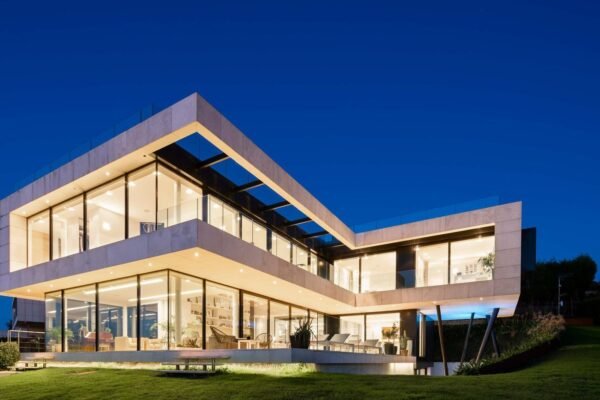
On an aluminium glazing specification, Ug is the U-value of the glass alone, Uf is the U-value of the frame alone, and Uw is the U-value of the finished window — glass, frame and the heat bridge at the glass edge, combined and weighted by area. SHGC and g-value both describe the fraction of solar energy that ends up inside the room, and SC (shading coefficient) is that same quantity expressed against 3 mm clear glass. For a Dubai villa, the three numbers the specification actually turns on are Uw, the shading coefficient and light transmittance — and none of them can be read safely without the test size and the boundary conditions printed beside them.
That last point is where most glazing comparisons quietly fall apart. Two datasheets can show the same figure and describe entirely different products — one quoting a frame, the other a whole window; one calculated at a European winter condition, the other at a Gulf summer one. This guide decodes the line items in the order they appear on a typical sheet.
What do Uw, Ug and Uf mean on a glazing spec sheet?
All three are thermal transmittance: the rate of heat flow through one square metre of the element for each degree of temperature difference across it, in W/m²K. Lower is better. They differ only in what is included.
Uw is not an average of Ug and Uf. It is an area-weighted calculation defined by EN ISO 10077-1, and it carries a third term that has nothing to do with either the glass or the frame:
Uw = (Ag · Ug + Af · Uf + lg · Ψg) / Aw
Ag and Af are the glass and frame areas, Aw is the total window area, lg is the total perimeter of the glass, and Ψg — the Greek letter psi — is the linear thermal transmittance of the spacer bar sealing the insulating glass unit, in W/mK. The standard accounts for the spacer separately because it short-circuits the cavity at the glass edge. A conventional aluminium spacer carries a psi value in the region of 0.08 W/mK; a warm-edge spacer is typically around a third of that.

The practical trap is the difference between Uf and Uw, because a good aluminium frame produces a flattering Uf. On our own aluminium window systems page you will find the Schüco AWS 90.SI+ published at Uf 0.71 W/m²K and the Cortizo COR 80 Industrial published at Uw from 0.71 W/m²K. The figures are identical and the claims are not: the first is a frame in isolation, the second is a whole window including its glass and spacer. Read the subscript before you read the number.
| Symbol | What it covers | Units | What to watch for |
|---|---|---|---|
| Ug | Glass only, centre of glass | W/m²K | Excludes the spacer and the frame entirely — always better than the window it sits in |
| Uf | Frame profile only | W/m²K | Depends on face width; a slimmer profile shows a different Uf on the same platform |
| Ψg (psi) | Glass-edge spacer, per metre of perimeter | W/mK | Rarely quoted to clients, but it is in the Uw calculation whether it is shown or not |
| Uw | Whole window as installed | W/m²K | Only meaningful with its test size stated |
| SHGC / g-value | Solar energy admitted, 0–1 | — | Different standards, different boundary conditions; check which one |
| SC | Solar gain relative to 3 mm clear glass | — | SC = SHGC ÷ 0.87; this is the form Al Sa’fat uses |
| LT / VLT | Visible light admitted, 0–1 or % | — | Al Sa’fat sets a minimum, not a maximum |
Why does the same aluminium window have more than one U-value?
Because Uw is a geometry calculation. Change the size of the window and you change the ratio of frame to glass and the length of glass edge per square metre — so the same profile with the same glass returns a different Uw.
The table below is a worked example, not a product claim. Every input is stated so it can be checked: Ug 1.1 W/m²K, Uf 1.7 W/m²K, a warm-edge spacer at Ψg 0.045 W/mK, a single fixed light, and a 100 mm frame face width all round. Uw is calculated with the EN ISO 10077-1 formula above and rounded to one decimal place as EN 673 requires. The middle row is the EN 14351-1 standard window declaration format.
| Window size | Frame as % of area | Glass perimeter | Calculated Uw |
|---|---|---|---|
| 0.60 × 0.90 m (bathroom light) | 48% | 2.20 m | 1.6 W/m²K |
| 1.23 × 1.48 m (EN reference size) | 28% | 4.62 m | 1.4 W/m²K |
| 3.00 × 2.40 m (villa picture window) | 14% | 10.00 m | 1.2 W/m²K |
Same system, same glass, three answers spanning 0.4 W/m²K, with nothing changed but the opening. Swap the warm-edge spacer for a plain aluminium one at Ψg 0.08 W/mK and the reference-size window moves from 1.4 to 1.5 W/m²K — a component most clients never see, moving the headline by a tenth.
This is why EN 14351-1 fixes the formats a declared Uw may be stated in: 1.23 m × 1.48 m for a window area of not more than 2.3 m², or 1.48 m × 2.18 m for all sizes where the Ug value is 1.9 W/m²K or better under EN 673. A Uw quoted with no size beside it is not comparable to anything — a discipline that matters as much for our aluminium sliding door systems as for casements, since a large sliding unit’s low frame fraction naturally flatters it.
What is the difference between g-value, SHGC and shading coefficient?
All three answer the same question — how much of the sun’s energy hitting the glass ends up as heat in the room — and all three are decimals where lower means less heat admitted. The differences are in method.
The g-value is the European figure, defined by EN 410 as the sum of the solar direct transmittance (τe, the energy that passes straight through) and the secondary internal heat transfer factor (qi, the portion absorbed in the glass and later released inwards by convection and long-wave radiation). It is usually quoted centre-of-glass.
SHGC is the American figure, determined under NFRC 200 at an outdoor temperature of 32 °C, an indoor temperature of 24 °C and 783 W/m² of incident solar radiation, and reported for the whole product including the frame. Because opaque framing admits less solar energy than glass does, a window unit’s SHGC is generally lower than the SHGC of the glass alone — the opposite direction to what the frame does to the U-value.
Shading coefficient is SHGC expressed against a reference: 3 mm clear glass, which has an SHGC of 0.87 and is assigned SC 1.00. To convert, divide SHGC by 0.87. This matters in the UAE more than anywhere, because Dubai’s green building code is written in shading coefficients while almost every glass datasheet publishes SHGC. A product listed at SHGC 0.27 is an implied SC of about 0.31 — comfortably inside a 0.40 ceiling, but you have to do the arithmetic to know it.
Al Sa’fat, Dubai’s mandatory green building system, states glazing performance as a summer U-value, a maximum shading coefficient and a minimum light transmittance, banded by how much of the external wall is glazed. Residential window-to-wall ratio is capped at 40%, which places a villa in the first band: under the 2nd edition (January 2023), Article 501.01(B), Silver Sa’fa requires a summer U-value of 2.1 W/m²K or better, SC of 0.40 or less, and light transmittance of 0.40 or more. We set those requirements out in full in our guide to Al Sa’fat and Estidama glazing requirements.
What boundary conditions is the U-value calculated at?
Every U-value is a calculation at an assumed set of conditions, and the assumptions are not the same across standards. This is the single most-missed line on a glazing submission.
EN 673 — the standard behind the Ug on a European glass datasheet — fixes the declared-value conditions in its Clause 8: a temperature difference of 15 K across the cavity, a mean gas-space temperature of 283 K (10 °C), an external heat transfer coefficient of 25 W/m²K, an internal coefficient of 7.7 W/m²K, and a corrected emissivity for uncoated soda-lime glass of 0.837. A sealed cavity sitting at a mean of 10 °C is a European heating-season condition. It is not a July afternoon in Al Barsha.
| Basis | Outside | Inside | Other conditions | Where you meet it |
|---|---|---|---|---|
| EN 673 (declared Ug) | 15 K across the cavity, gas space mean 10 °C | he 25, hi 7.7 W/m²K | European glass and system datasheets | |
| NFRC 100 winter | −18 °C | 21 °C | Wind 5.5 m/s, no solar | The default U-factor on an NFRC label |
| NFRC 200 summer | 32 °C | 24 °C | Wind 2.75 m/s, 783 W/m² solar | SHGC, and the summer U-factor |
| Al Sa’fat | Summer U-value | Stated with SC and LT limits | Dubai Municipality compliance | |
The direction of the discrepancy is counter-intuitive and worth stating plainly. For most glass the summer U-value comes out lower than the winter one, mainly because the assumed outdoor wind speed is lower, which reduces convective heat transfer at the external face. A winter-basis figure is therefore not automatically an optimistic one. The problem is not bias but comparability: three products quoted on three different bases cannot be ranked against each other, and only one of those bases is what Dubai Municipality asks for.
One further unit trap. NFRC labels report U-factor in Btu/hr·ft²·°F, not W/m²K. To convert to metric, multiply by 5.678. A window labelled U-factor 0.28 is 1.6 W/m²K — a figure that reads as excellent in imperial and merely adequate against an Al Sa’fat band.
What does light transmittance tell you, and what is the LSG ratio?

Light transmittance (LT, or VLT in North American datasheets) is the fraction of visible light that passes through, and in Dubai it is the constraint that rules out the easy answers. Al Sa’fat sets LT as a minimum, so the crude route to a low shading coefficient — a dark tint or a heavily reflective coating — fails the daylight floor at the same time as it passes the solar ceiling.
The metric that reconciles the two is light-to-solar gain: LSG = VLT ÷ SHGC. It expresses how much daylight a glass delivers per unit of solar heat admitted, and an LSG of 1.25 or above is the threshold commonly used to classify a glass as spectrally selective. A high-selectivity coating is what lets a villa hold a generous glass area, meet a 0.40 shading-coefficient ceiling and still clear a 0.40 light-transmittance floor — the argument we set out in our assessment of low-E glass in the UAE.
What should you check before signing off an aluminium glazing specification?
- Which U is it? Confirm whether the figure is Ug, Uf or Uw. If the sheet says Uf, ask for the Uw.
- At what size? A Uw without a test size is not comparable. Ask for the declaration format, and compare like for like.
- On what basis? EN 673, NFRC winter, NFRC summer — and does it match what the authority asks for.
- SHGC or SC? Convert before you compare against a code limit, and state the conversion in the submission.
- What is the light transmittance? Check it against the minimum, not just the solar ceiling.
- What spacer? The psi value is inside the Uw whether or not it is printed.
- Centre-of-glass or whole product? Glass figures and unit figures are not interchangeable in either direction.
We quote system data as the manufacturer declares it — whole-window Uw where they declare Uw, frame Uf where they declare Uf. The Altest LineaWin 7200 is listed at Uw ≥1.2 W/m²K on a 30 mm sightline, the Cortizo COR 80 Industrial at Uw from 0.71 W/m²K on a 45 mm tubular polyamide break, and the Alumil SMARTIA S77 at Uf from 0.85 W/m²K. The same discipline applies to large-format work, where the low frame fraction of an oversized aluminium pivot door flatters the arithmetic — but only if the number quoted includes the frame.
Frequently asked questions
What is the difference between Ug, Uf and Uw?
Ug is the thermal transmittance of the glass alone, measured at the centre of the glass. Uf is the thermal transmittance of the frame alone. Uw is the thermal transmittance of the whole window — glass, frame and the linear heat bridge at the glass edge combined, weighted by area under EN ISO 10077-1. Uw is the only one of the three that describes what gets installed in the wall.
Is g-value the same as SHGC?
They measure the same physical quantity — the fraction of incident solar energy that ends up inside, by direct transmission plus re-radiated absorbed heat. They are not calculated the same way. The European g-value follows EN 410 and is usually quoted centre-of-glass; SHGC follows the American NFRC 200 procedure at 32 °C outside, 24 °C inside and 783 W/m² of solar radiation, and is a whole-product figure. Treat them as close cousins, not as interchangeable numbers.
How do I convert SHGC to shading coefficient?
Divide SHGC by 0.87. The shading coefficient expresses solar heat gain relative to 3 mm clear glass, which is assigned a value of 1.00 and has an SHGC of 0.87. This conversion matters in Dubai because Al Sa’fat states its limits as a shading coefficient while most manufacturer datasheets publish SHGC.
Why does the same aluminium window have more than one U-value?
Because Uw depends on geometry as well as materials. A small window has proportionally more frame and more glass-edge perimeter per square metre than a large one, so the same profile and the same glass produce a higher (worse) Uw at a small size. That is why a declared Uw is only meaningful with its test size attached, and why EN 14351-1 fixes standard declaration formats.
Does Al Sa’fat use a winter or a summer U-value?
Al Sa’fat states glazing limits as a summer U-value, alongside a maximum shading coefficient and a minimum light transmittance. European datasheets declare Ug under EN 673 at a mean gas-space temperature of 10 °C, and NFRC’s most commonly quoted U-factor is the winter-nighttime condition. None of the three are the same basis, so a compliance submission needs the figure calculated on the basis the code asks for.
What is the LSG ratio and what is a good value?
Light-to-solar-gain is visible light transmittance divided by SHGC. It measures how much daylight a glass delivers per unit of solar heat admitted, and an LSG of 1.25 or above is the benchmark commonly used to classify glazing as spectrally selective. In Dubai it is the number that decides whether you can meet a shading-coefficient ceiling and a light-transmittance floor at the same time.
Specify from the right number
A glazing specification is only as good as the figures underneath it, and most of the risk on a Dubai villa sits in the gap between a datasheet headline and the assembly that arrives on site. Closing it is a conversation about opening sizes, orientation, glass build-up and compliance band.
If you are working through a glazing package and want the numbers interrogated properly, our technical team will review your schedule of openings and set out the Uw, shading coefficient and light transmittance you need band by band, calculated at your sizes. Talk to us about your specification, or browse the systems and published performance data on our aluminium windows page.
Sources. BS EN 673:2011, Clause 8 (declared-value boundary conditions). EN ISO 10077-1 whole-window formula and EN 14351-1 declaration formats, via Bundesverband Flachglas Bulletins 004/2018 and 007/2017. EN 410 (g-value as solar direct transmittance plus secondary internal heat transfer factor). NFRC 100 and NFRC 200 environmental conditions. Vitro Architectural Glass, “Understanding Framing and Performance Values”, on centre-of-glass versus whole-product ratings. Shading coefficient conversion (SC = SHGC ÷ 0.87) per Trane technical reference. Light-to-solar-gain definition and the 1.25 selectivity benchmark per Cardinal Glass and Guardian Glass glossaries. Al Sa’fat – Dubai Green Building System, 2nd edition (January 2023), Article 501.01(B). System performance figures as published on laa.ae. The three-size Uw table is LAA’s own worked example with all inputs stated; it is a demonstration of the standard’s method, not a product performance claim.