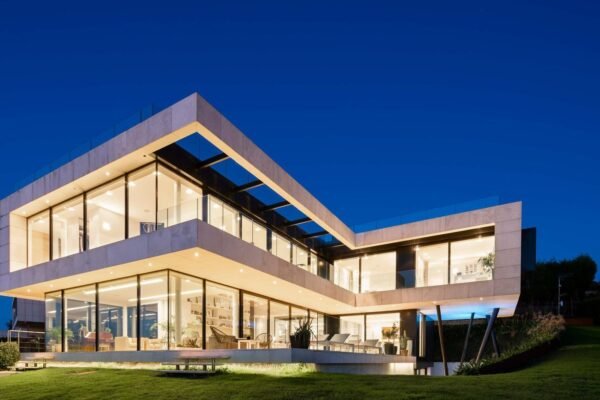
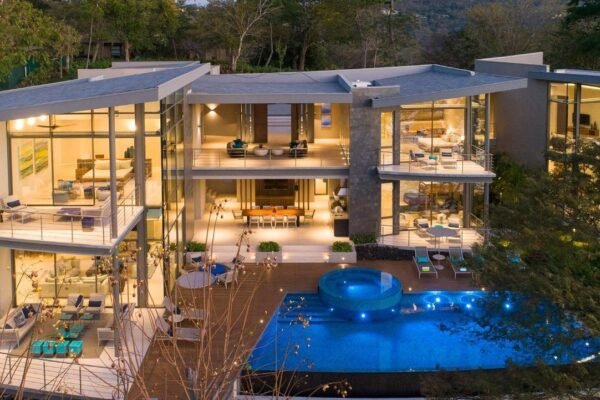
Every new building in Dubai must meet the Silver Sa’fa level of Al Sa’fat, Dubai Municipality’s green building system. For a villa — where Al Sa’fat caps the window-to-wall ratio of residential buildings at 40% — that means the glazing must achieve a summer U-value of 2.1 W/m²K or lower, a shading coefficient of 0.4 or lower, and a light transmittance of 0.4 or higher. Buildings targeting the voluntary Golden or Platinum Sa’fa tighten those to 1.9 W/m²K, SC 0.32 and LT 0.32. In Abu Dhabi, the equivalent baseline is Estidama’s Pearl Villa Rating System, which sets fenestration at U 2.2 W/m²K and SHGC 0.4.
Those four numbers decide most of what a specifier can and cannot put in a Gulf façade. Below is what the current regulation actually says, where aluminium framing enters the picture, and the one clause that quietly rules out the obvious solution.
What is Al Sa’fat, and does it apply to my villa?
Al Sa’fat is Dubai Municipality’s green building evaluation system. It replaced the earlier Dubai Green Building Regulations and Specifications on 19 October 2020, and the current text is the 2nd edition, issued January 2023. It is a rating system rather than a simple code: Dubai Municipality describes a set of mandatory requirements that all new buildings must meet to obtain the Silver Sa’fa, with owners seeking higher performance able to apply additional requirements for the Golden or Platinum Sa’fa.
The practical reading for a homeowner is straightforward. Silver is not an aspiration — it is the floor. If your project needs a Dubai Municipality building permit, the glazing schedule has to clear the Silver figures before anything else is discussed.
One point that catches people out: an older first edition of Al Sa’fat set Bronze as the minimum rating. That edition is superseded, and Dubai Municipality marks it as such. Specifications still quoting Bronze thresholds are working from a withdrawn document.

What glazing performance does Al Sa’fat actually require?
Article 501.01 sets the minimum building envelope performance. Glazing requirements are banded by window-to-external-wall ratio (WWR) — the more glass in the façade, the harder the targets. Note that Al Sa’fat specifies shading coefficient (SC), not SHGC, and that light transmittance is a minimum, not a maximum.

| Window-to-wall ratio | Metric | Silver Sa’fa | Golden & Platinum Sa’fa |
|---|---|---|---|
| Less than 40% | Summer U-value (W/m²K) | 2.1 max | 1.9 max |
| Shading coefficient (SC) | 0.4 max | 0.32 max | |
| Light transmittance | 0.4 min | 0.32 min | |
| 40% to 60% | Summer U-value (W/m²K) | 1.9 max | 1.7 max |
| Shading coefficient (SC) | 0.32 max | 0.25 max | |
| Light transmittance | 0.32 min | 0.25 min | |
| Greater than 60% | Summer U-value (W/m²K) | 1.7 max | 1.5 max |
| Shading coefficient (SC) | 0.25 max | 0.25 max | |
| Light transmittance | 0.25 min | 0.25 min |
Source: Al Sa’fat – Dubai Green Building System, 2nd edition (January 2023), Tables 501.01 (2)–(4).
Two further limits matter on villa projects. Al Sa’fat caps the total WWR of glazed façades to conditioned spaces at 40% of gross wall area for residential buildings (60% for other building types), so a villa sits in the first band by definition. And roof glazing is treated separately: where glazing is 10% or less of the roof area it must meet U 1.9 W/m²K, SC 0.32 and LT 0.32; above 10%, SC and LT tighten to 0.25.
Why can’t I just fit the darkest glass available?
This is the clause that reshapes most specifications. Al Sa’fat sets shading coefficient as a maximum and light transmittance as a minimum, and both apply at once. A villa at Silver must therefore keep SC at or below 0.4 while keeping light transmittance at or above 0.4.
A heavily body-tinted or reflective glass will hit the solar target easily and then fail the daylight one. Working the two limits together, the glazing needs a light-to-solar-gain ratio of roughly 1.15 or better (0.4 light transmittance against an SHGC of about 0.35). That ratio is the signature of a spectrally selective low-E coating — a coating that rejects near-infrared radiation while passing visible light — rather than a tint. The same arithmetic holds at Golden and Platinum, where 0.32 against 0.32 lands at the same ratio.
The regulation, in other words, does not merely ask for less heat. It asks for less heat without going dark, and that is a coating specification, not a glass-colour choice.
Converting shading coefficient to SHGC
Most international glass datasheets quote SHGC or g-value; Al Sa’fat is written in shading coefficient. The two relate through clear 3 mm glass, so SHGC ≈ SC × 0.87:
| Al Sa’fat shading coefficient | Equivalent SHGC (approx.) | Where it applies |
|---|---|---|
| 0.40 max | 0.35 | Silver, WWR under 40% (typical villa) |
| 0.32 max | 0.28 | Golden/Platinum villa; Silver at 40–60% WWR |
| 0.25 max | 0.22 | Highly glazed façades and roof glazing over 10% |
We cover the mechanics of solar gain versus conductive gain in more depth in our guide to aluminium double glazing and Dubai AC costs.
Where does the aluminium frame come into it?
Directly — and by name. Article 501.02 requires that thermal bridges be eliminated or efficiently insulated, and it lists where they occur: connection points between concrete or steel beams, external walls and columns, and around doors and windows. Untreated aluminium is an excellent conductor; a frame without a thermal break is precisely the bridge the clause describes.

For villas specifically, Al Sa’fat offers an alternative route: thermal bridges can be avoided by raising envelope efficiency such that the average U-value of the building envelope does not exceed 0.40 W/m²K. That is a demanding whole-envelope figure, and it is not reached with glazing that performs to the bare minimum.
The engineering answer in both cases is the same. A polyamide thermal break separates the internal and external aluminium profiles, interrupting the conductive path through the frame while retaining aluminium’s structural advantage — the reason it carries the spans and slim sightlines that villa architecture in Dubai is built around. The aluminium window systems we fabricate include Cortizo’s COR 80 Industrial, with a 45 mm tubular polyamide thermal break and Uw from 0.71 W/m²K, and the Altest WDS70 at Uw 0.9 W/m²K. Both sit far inside the Al Sa’fat envelope, which leaves headroom for the glass specification rather than spending it all on the frame.
One caution on reading datasheets: Al Sa’fat asks for the average thermal transmittance of the element. A centre-pane Ug figure describes the glass alone and will always flatter the assembly. The number that answers the regulation is the whole-window Uw, frame included — a distinction we set out in our guide to U-values for UAE villas.
Sealing matters too. Article 501.05 requires air-conditioned buildings with a cooling load of 1 MW or greater to achieve air leakage no greater than 5 m³/h/m² at an applied pressure difference of 50 Pa. Villas fall below that threshold, but the principle carries: a compliant unit fitted into an unsealed opening does not deliver a compliant façade. Large moving elements such as aluminium sliding doors depend on gasket design and installation tolerance for the performance their datasheet promises.
How does Abu Dhabi’s Estidama differ?
Abu Dhabi uses Estidama and its Pearl Rating System. For homes, the relevant document is the Pearl Villa Rating System, where a 1 Pearl rating requires all mandatory credits to be met, and higher ratings add credit points on top — 30 points for 2 Pearl, 44 for 3 Pearl, and so on.
The mandatory RE-R1 Minimum Energy Performance credit sets the prescriptive envelope. The structural difference from Dubai is worth noting: Estidama measures the glazing allowance against conditioned floor area, while Al Sa’fat measures it against wall area.
| Requirement | Dubai — Al Sa’fat (Silver, villa) | Abu Dhabi — Estidama (1 Pearl villa) | Estidama enhanced (extra credit) |
|---|---|---|---|
| Fenestration U-value | 2.1 W/m²K max | 2.2 W/m²K max | 1.9 W/m²K max |
| Solar control | SC 0.4 max (SHGC ≈ 0.35) | SHGC 0.4 max | SHGC 0.3 max |
| Light transmittance | 0.4 min | Not prescribed | Not prescribed |
| Glazing area limit | 40% of gross wall area | Under 15% of conditioned floor area | Under 10% of conditioned floor area |
| Roof U-value | 0.3 W/m²K max | 0.14 W/m²K max | 0.12 W/m²K max |
| Wall U-value | 0.57 W/m²K max | 0.32 W/m²K max | 0.29 W/m²K max |
| Air infiltration | Not prescribed for villas | 0.35 ACH max | 0.20 ACH max |
Sources: Al Sa’fat 2nd edition (January 2023), Article 501; Estidama Pearl Villa Rating System, Design & Construction, Version 1.0, credits RE-R1 and RE-2.
Estidama also awards credit for shading rather than glass alone — a vertical mashrabiya-style screen on east and west elevations with maximum 20% free area, and horizontal projections to the south. It is a reminder that in Gulf climates the orientation of glass is as much a performance variable as its coating. Al Sa’fat takes the same view, requiring glazed façades at Golden and Platinum level between 112.5° and 247.5° — southeast through southwest — to be treated environmentally.
What should you ask a glazing supplier for?
Five questions separate a compliant submission from a rejected one:
- Whole-window Uw, not centre-pane Ug. Ask which one the quoted figure is, and for what size of unit.
- Both SC and SHGC. Dubai Municipality assesses shading coefficient; the glass processor will usually quote SHGC.
- Light transmittance. The minimum is a compliance limit in its own right, not a comfort preference.
- The window-to-wall ratio the design assumes. A façade change that pushes past a band boundary changes every target with it.
- How the thermal break is constructed. Polyamide depth and profile geometry are what the frame contributes to the assembly figure.
Get those five right at design stage and compliance is a documentation exercise. Get them wrong and the correction arrives as a re-glazing cost after the permit review.
Specifying with confidence
Al Sa’fat is not an obstacle to ambitious glazing — it is a floor that rewards proper engineering. A villa can carry generous, slim-sightline aluminium glazing within a 40% window-to-wall ratio and clear Silver comfortably, provided the frame is genuinely thermally broken and the glass is spectrally selective rather than simply dark. The specifications that struggle are the ones that treat performance as something to be checked after the aesthetic is fixed.
If you are working through a glazing schedule for a Dubai villa or a specification package that has to satisfy Dubai Municipality, our technical team can review the targets against real system data — including oversized pivot doors and large sliding elements where compliance and span have to be resolved together. We would be glad to have that conversation early, while it is still a drawing.