

Aluminium windows cut a Dubai cooling bill by reducing the two ways heat enters through glazing: solar heat gain through the glass and conductive heat flow through the frame. In a climate where air conditioning is the dominant energy cost, a thermally broken aluminium frame paired with high-performance, solar-control glazing can lower a whole window’s U-value to around 2.0 W/m²K and its solar heat gain coefficient (SHGC) to about 0.25 — down from roughly 5.7 W/m²K and 0.70 for single-glazed, non-broken aluminium. Less heat crossing the glass means less cooling load, and a smaller DEWA bill.
This guide explains the mechanism, sets out the U-value and SHGC to specify for a Dubai villa under Al Sa’fat, and works a transparent savings example with every assumption stated — for the villa owner watching a summer DEWA bill climb, and the architect or contractor writing the specification.
How much of a Dubai cooling bill comes through the windows?
Air conditioning typically accounts for around 60–70% of a Dubai home’s electricity consumption during the cooling season, and villas sit at the higher end because they have more exposed elevations, larger glazed areas and greater roof and wall gain than apartments. Glazing is the weakest thermal link in most homes: glass conducts heat far faster than an insulated wall, and it admits solar radiation directly into the room.
That makes windows a disproportionately large lever. A wall assembly might carry a U-value under 0.3 W/m²K; ordinary single glazing sits near 5.7 W/m²K — roughly twenty times more conductive per square metre. Add direct solar gain through the pane, and the glazing line becomes the first place a specifier should look to bring cooling load down.
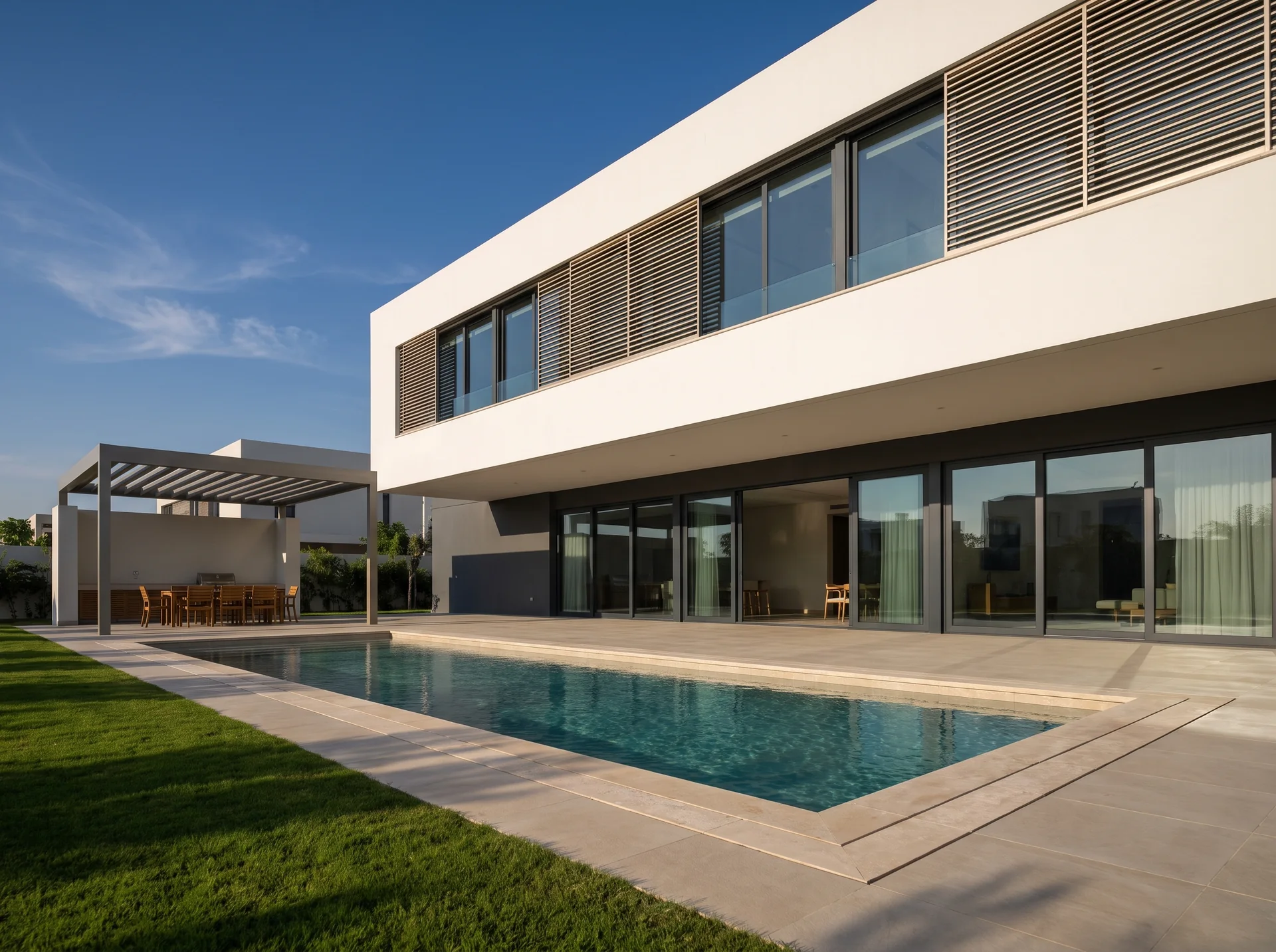

How do aluminium windows actually cut cooling load?
Two independent physics mechanisms are at work, and a good specification addresses both.
Conductive heat flow is governed by the U-value (for a whole window, Uw): the lower the number, the slower heat conducts from the hot outside to the cooled interior. A thermally broken aluminium frame is built in two halves — an outer and an inner aluminium section — bonded by a strip of low-conductivity polyamide. That polyamide barrier interrupts the direct metal path heat would otherwise take straight through the frame, which is why a quality thermally broken frame reaches whole-window U-values in the 1.8–2.5 W/m²K range, while a non-broken aluminium frame is far more conductive.
Solar heat gain is governed by the SHGC (also expressed as the glass g-value): the fraction of incident solar energy that passes through the glazing as heat. This is controlled at the glass, not the frame — principally by a low-emissivity (low-E) solar-control coating and, in a double-glazed insulated glass unit (IGU), an argon-filled cavity. A high-performance solar-control IGU can bring SHGC down to around 0.25 while keeping useful daylight.
In Dubai’s cooling-dominated climate, the solar gain term usually matters more than the conductive term — a point we quantify in the worked example below. The systems that deliver both, such as Schüco, Cortizo, Alumil and Altest, all rely on the same principles: a thermal break in the frame and a coated, gas-filled IGU in the aperture.
Frame and glazing performance compared
| Configuration | Whole-window U (Uw, W/m²K) | Typical SHGC | Effect in Dubai’s heat |
|---|---|---|---|
| Single glazing, non-thermally-broken aluminium | ~5.7 | ~0.70 | High conduction and high solar gain — heaviest cooling load |
| Standard double glazing, non-broken aluminium frame | ~3.0–3.5 | ~0.55–0.70 | Better glass, but the metal frame still bridges heat |
| Thermally broken aluminium + low-E double glazing (argon) | ~1.8–2.5 | ~0.25–0.35 | Low conduction and controlled solar gain — meets Al Sa’fat |
Values are typical ranges for specification guidance; the exact figures come from the chosen system’s tested datasheet.
What U-value and SHGC should you specify for a Dubai villa?
Dubai’s Al Sa’fat Green Building System sets the regulatory floor. Under the current requirements, glazing is expected to meet a U-value of approximately 2.0 W/m²K, with an SHGC ceiling near 0.25 for highly glazed façades (rising to around 0.35 where glazing covers a smaller share of the elevation). Al Sa’fat Silver is the mandatory baseline for new buildings, with Gold, Platinum and Emerald above it.
For a premium villa, treat those numbers as the minimum, not the target. Specifying a whole-window Uw at or below 2.0 W/m²K and an SHGC of around 0.25 keeps you compliant and comfortable, and it protects resale value as green-building expectations tighten. The critical detail is to specify the whole-window U-value (Uw), not just the centre-of-glass figure (Ug) — a superb IGU let down by a conductive frame will underperform its glass rating in practice.
How much can aluminium windows actually save? A worked example
There is no honest single percentage, because the answer depends on glazed area, orientation, shading and how many hours the system runs. What we can do is show the physics transparently, with every assumption on the table, so you can see where the saving comes from.
Assumptions (illustrative): 40 m² of sunlit glazing on a villa’s exposed elevations; interior set point 24°C against a peak outdoor 40°C, so ΔT = 16 K; peak solar irradiance on the sunlit glass ≈ 500 W/m² (orientation-dependent). We compare existing single-glazed, non-broken aluminium (Uw ≈ 5.7 W/m²K, SHGC ≈ 0.70) against a thermally broken aluminium upgrade with low-E double glazing (Uw ≈ 2.0 W/m²K, SHGC ≈ 0.25).
Conductive gain (Q = U × A × ΔT): existing 5.7 × 40 × 16 ≈ 3.6 kW; upgraded 2.0 × 40 × 16 ≈ 1.3 kW — about 2.4 kW removed.
Solar gain (Q = SHGC × A × irradiance): existing 0.70 × 40 × 500 ≈ 14.0 kW; upgraded 0.25 × 40 × 500 ≈ 5.0 kW — about 9.0 kW removed.
| Heat-gain path (at assumed peak) | Existing single glazing | Upgraded aluminium | Reduction |
|---|---|---|---|
| Conductive (U × A × ΔT) | ~3.6 kW | ~1.3 kW | ~2.4 kW |
| Solar (SHGC × A × irradiance) | ~14.0 kW | ~5.0 kW | ~9.0 kW |
| Total through glazing | ~17.6 kW | ~6.3 kW | ~11.4 kW |
At these assumed peak conditions, roughly 11.4 kW of heat gain no longer has to be removed by the air conditioning — and note that solar gain accounts for the large majority of it, which is why SHGC deserves at least as much attention as U-value. If the cooling system runs at a coefficient of performance (COP) of about 3, it draws roughly 1 kW of electricity for every 3 kW of heat it removes, so that 11.4 kW of avoided gain is on the order of 3.8 kW less electrical demand at peak. On DEWA’s top residential slab of 38 fils/kWh, that is about AED 1.44 for each hour spent at peak load. The seasonal total compounds across thousands of cooling hours — but the defensible number for a specific home comes from a modelled survey, not a headline percentage.
For reference, DEWA’s residential electricity tariff is a slab structure: 23 fils/kWh up to 2,000 kWh a month, 28 fils to 4,000 kWh, 32 fils to 6,000 kWh, and 38 fils/kWh above that, before the fuel surcharge and 5% VAT. Because the rate rises with consumption, cutting the summer peak trims units off the most expensive slab first — which is where glazing upgrades pay back hardest.

Does the frame matter, or just the glass?
Both, and they fail in different ways. Upgrade the glass to a low-E IGU but keep a non-thermally-broken aluminium frame, and the metal continues to bridge heat straight through the perimeter — the frame becomes the limiting factor, and in humid conditions it can even sweat with condensation as its internal face runs cold in winter and hot in summer. The polyamide thermal break is what stops that bridge, keeping the internal frame face closer to room temperature and letting the whole window achieve the U-value its glass promises.
This is also why aluminium remains the premium choice in the Gulf. Engineered correctly — a proper thermal break, a well-sealed IGU and precise factory fabrication — aluminium delivers the slim sightlines and large spans a modern villa wants, the structural strength for oversized aluminium sliding doors and pivots, and the UV and heat durability that suits Dubai far better than uPVC. The performance comes from the system and the fabrication.
Frequently asked questions
Do aluminium windows really reduce a Dubai DEWA bill?
Yes — indirectly, by cutting cooling load. Air conditioning is around 60–70% of a Dubai home’s electricity use, and thermally broken aluminium windows with solar-control glazing reduce both the solar heat gain and the conductive heat flow that the AC must otherwise remove. Less cooling load means fewer kWh billed, especially on DEWA’s higher consumption slabs.
What U-value should windows have for a villa in the UAE?
Aim for a whole-window U-value (Uw) at or below 2.0 W/m²K, in line with Dubai’s Al Sa’fat requirements. Specify the whole-window figure, not just centre-of-glass, so the frame’s contribution is included.
Is SHGC or U-value more important in Dubai?
In a cooling-dominated climate, SHGC usually matters more. Solar heat gain through the glass is typically the larger load, so a low SHGC (around 0.25 for a highly glazed façade) does more to cut cooling demand than U-value alone — though a low U-value is still needed for compliance and comfort.
What is a thermal break and why does it matter here?
A thermal break is a strip of low-conductivity polyamide bonded between the inner and outer halves of an aluminium frame. It interrupts the metal’s direct heat path, lowering the frame’s U-value and keeping its internal face closer to room temperature — which reduces heat flow and helps prevent condensation.
Are double-glazed aluminium windows enough, or do I need triple glazing?
For most Dubai villas, a well-specified low-E double-glazed IGU with argon fill and a thermally broken frame meets Al Sa’fat and delivers strong performance. Triple glazing adds cost and weight for gains that matter more in cold climates than in a cooling-led one; the bigger wins here come from a low SHGC coating and a proper thermal break.
Will low-E solar-control glass make rooms dark?
No. Modern spectrally selective low-E coatings are designed to reject infrared (heat) while transmitting visible light, so you keep daylight and views while cutting solar heat gain. The balance between light and solar control is a glass selection your specifier can tune per elevation.
Specify it once, correctly
The saving is real, but it is a specification outcome, not a product off a shelf: the right whole-window U-value, the right SHGC for each orientation, a genuine polyamide thermal break, and factory fabrication tight enough that the tested performance survives into the installed reality. Get those right and the glazing stops being the weak thermal link and starts protecting the DEWA bill every summer.
At London Architectural Aluminium, we engineer and fabricate thermally broken aluminium windows in Dubai to meet Al Sa’fat and the performance a premium villa demands, and we can model the numbers for your elevations rather than quote a headline percentage. For a specification conversation or a site survey, see our full aluminium doors and windows specification guide or speak to our technical team.